
FPO Registration in India: Process, Documents & Fees
Starting a Farmer Producer Organisation (FPO) can help farmers buy agricultural inputs together, sell produce collectively and build a stronger agricultural business. Before applying, however, you need to choose the right legal structure, prepare the required documents and understand the costs involved.
This guide explains how FPO registration works in India, the documents you may need, the registration process, possible costs and the responsibilities that follow registration.
What Is an FPO?
A Farmer Producer Organisation (FPO) is an organisation formed by farmers to improve their agricultural activities and business opportunities.
By working together, members can purchase seeds and fertilisers collectively, combine produce for sale, negotiate with buyers and explore activities such as grading, processing, packaging and storage.
For example, individual farmers may struggle to supply a large buyer consistently. An FPO can help them aggregate their produce and approach buyers as a group.
The objective is not simply to register an organisation. It is to build a business that benefits its farmer-members.
What Is the Difference Between an FPO and an FPC?
FPO is a broad term for a Farmer Producer Organisation. Farmer Producer Company (FPC) is one legal structure through which eligible producers can organise their business.
Depending on the group’s requirements and applicable law, a Producer Organisation may be formed as a Producer Company or under an appropriate cooperative framework. APEDA provides an overview of the legal forms available for Producer Organisations.
A Producer Company follows the applicable provisions of company law and is managed through its members and Board of Directors. A cooperative follows the relevant state or central cooperative law and its bye-laws.
Before choosing a structure, consider the proposed business, membership, governance, area of operation and applicable compliance requirements. Eligibility for a government scheme should also be checked separately.
Who Can Form an FPO in India?
Eligibility depends on the legal structure selected.
Farmer Producer Company
A Farmer Producer Company must satisfy the applicable requirements of the Companies Act, 2013, including the provisions relating to Producer Companies.
Before proceeding, check:
-
Whether the proposed members qualify as producers or eligible producer institutions.
-
Whether the applicable membership requirements are met.
-
Whether the proposed directors satisfy the legal conditions.
-
Whether the proposed business objectives are permitted.
-
Whether the proposed company name is available.
-
Whether the members are prepared to contribute share capital and provide the required documents.
Not everyone interested in agriculture automatically qualifies as a member of a Producer Company.
Cooperative FPO
A cooperative FPO must comply with the relevant state or central cooperative law. Membership requirements, governance rules and registration procedures may differ.
Requirements under a particular government scheme are not necessarily universal registration requirements for every FPO. Confirm the applicable law and scheme conditions separately.
Documents Required for FPO Registration
The exact document checklist depends on the legal structure and current filing requirements. The following are common document categories to prepare.
Documents Required for Farmer Producer Company (FPC) Registration in India
The proposed members and directors should prepare the following documents and information, as applicable under the current MCA incorporation process:
-
PAN and identity proof of subscribers and directors, as applicable.
-
Residential address proof of relevant subscribers and directors, particularly those without an existing DIN.
-
Digital Signature Certificates (DSCs) for individuals required to sign the electronic incorporation forms.
-
Director details and identification information, including DIN or details needed for its allotment.
-
Registered office proof, such as an ownership document or rent/lease agreement, as applicable.
-
Owner’s No-Objection Certificate (NOC) and other premises-related documents, where required.
-
Memorandum of Association (MoA) and Articles of Association (AoA) in the prescribed format.
-
Subscriber details and signed subscriber list, as required by the filing process.
-
Prescribed declarations, consents and incorporation forms, as applicable.
-
Evidence of producer eligibility, if required under the applicable MCA filing instructions.
Important: The exact attachments depend on the current MCA forms, the circumstances of the subscribers and directors, and the applicable filing requirements. Check the latest instructions on the Ministry of Corporate Affairs website before submitting the application.
Documents Required for Cooperative FPO Registration in India
Depending on the applicable state or central cooperative law, the following documents and information may be required:
-
Prescribed registration application submitted to the relevant Registrar of Cooperative Societies.
-
Proposed bye-laws defining the cooperative’s membership, governance, objectives and operations.
-
Promoter/member list with the required identity and address proofs.
-
Details of the proposed society, including its name, objectives, activities and area of operation.
-
Registered office address proof and supporting premises documents, where required.
-
Promoters’ resolutions and declarations, including details of the authorised applicant or chief promoter, where applicable.
-
Share capital or membership contribution details, along with supporting evidence where required.
-
Bank certificate and viability scheme, if required under the applicable registration route.
Important: Requirements vary by state and registration type. For example, the Ministry of Cooperation’s published checklist for multi-state cooperative societies specifically requires Form I, four copies of the proposed bye-laws, a bank certificate, a viability scheme, member details and prescribed resolutions. These requirements should not be assumed to apply to every state-level cooperative FPO.
Confirm the latest document checklist with the relevant Registrar before applying.
FPO Registration Process in India: Step by Step
The registration process depends on the legal structure. First decide which route is suitable for your group.
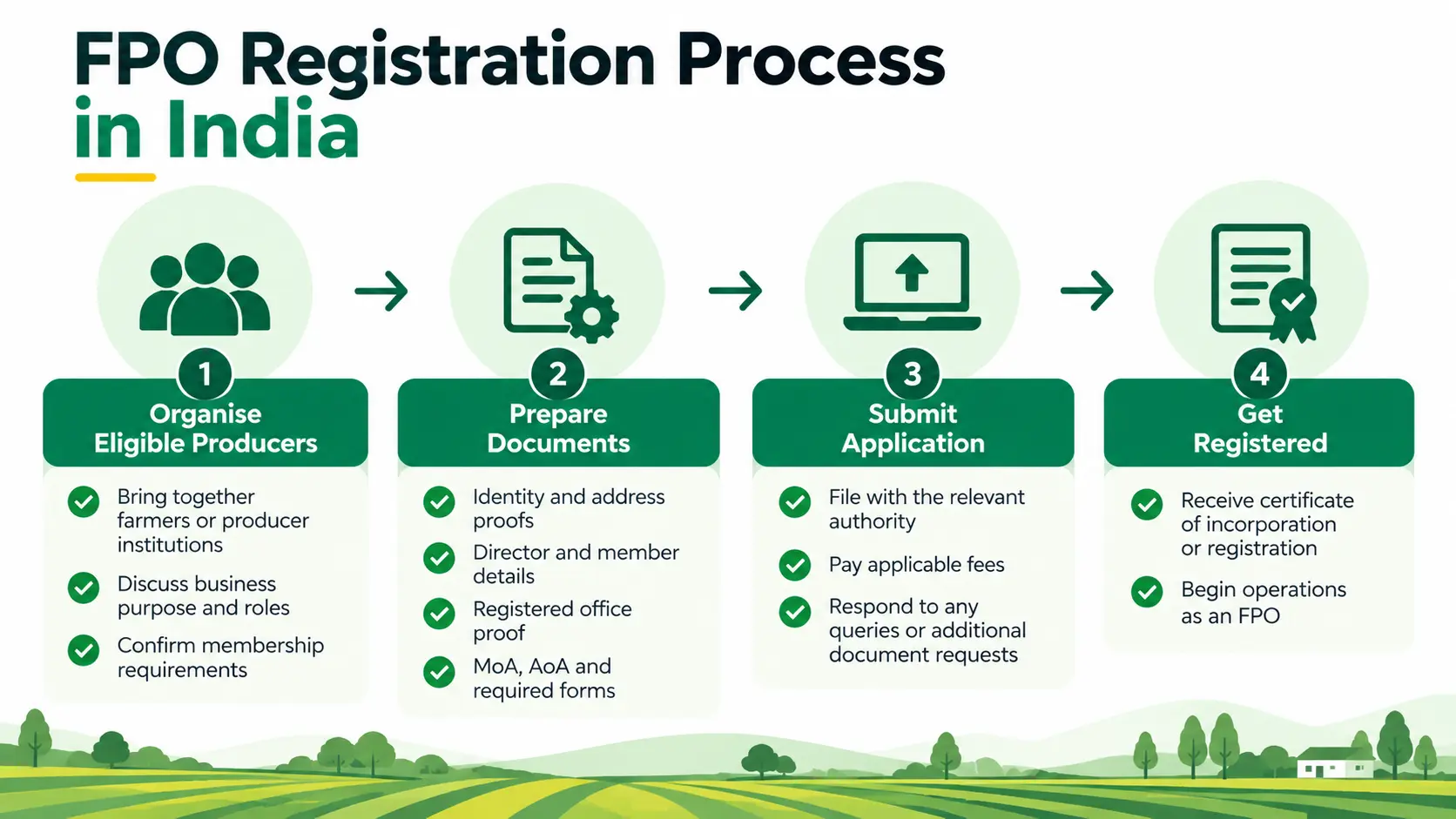
Route 1: Farmer Producer Company Registration
Step 1: Organise eligible producers
Bring together the producers who want to establish the company. Discuss the business purpose, member responsibilities and willingness to contribute share capital.
Step 2: Decide the business objectives
Identify the activities the company intends to undertake, such as input supply, produce aggregation, marketing or processing. The objectives must comply with the applicable law.
Step 3: Select the company name
Choose a suitable name and check it against MCA naming requirements. A name selected by the group is not automatically approved.
Step 4: Arrange digital signatures and director details
Prepare the required Digital Signature Certificates and complete the applicable director identification requirements.
Step 5: Prepare the incorporation documents
Prepare the MoA, AoA, registered office documents, declarations and other prescribed forms. The MoA sets out the company’s objectives, while the AoA covers its internal management rules.
Step 6: Submit the incorporation application
File the prescribed application and supporting documents through the current MCA electronic filing system. Review the details carefully before submission.
Step 7: Respond to queries and obtain approval
If the authority requests clarification or corrections, respond as required. Once the application is approved, the company receives its Certificate of Incorporation.
Confirm the latest forms and supporting documents through MCA instructions or with a qualified professional before filing.
Route 2: Cooperative FPO Registration
Step 1: Identify the applicable law
Confirm whether the organisation should register under the relevant state cooperative law or a central framework.
Step 2: Organise promoter members
Confirm the members’ eligibility and the minimum membership requirement under the applicable law.
Step 3: Form a provisional committee, if required
Follow the prescribed procedure for appointing a chief promoter or authorised representatives.
Step 4: Select the name and prepare the bye-laws
Prepare the proposed name and bye-laws in accordance with the applicable law. The bye-laws generally cover membership, governance, meetings, management and activities.
Step 5: Arrange contributions and supporting documents
Prepare any required membership contributions and supporting evidence according to the Registrar’s instructions.
Step 6: Submit the application
File the prescribed application and documents with the relevant registration authority.
Step 7: Complete the registration process
Respond to queries or requests for corrections. Registration is completed when the authority approves the application under the applicable procedure.
The exact sequence, forms, membership requirements and timeline depend on the relevant cooperative law. Confirm them with the Registrar before proceeding.
How Much Does FPO Registration Cost?
There is no single registration fee that applies to every FPO in India. The total cost depends on the legal structure, government charges, stamp duty, documentation and whether professional assistance is used.
For a Farmer Producer Company, possible cost components include:
-
Government filing charges.
-
Stamp duty applicable to the documents and state.
-
Digital Signature Certificates for relevant signatories.
-
Professional fees, if assistance is used.
-
Documentation and incidental expenses.
For a cooperative FPO, check the applicable registration fees and other charges with the relevant Registrar.
Before proceeding, obtain a written estimate that separates government charges, stamp duty, professional fees and other expenses.
Remember that share capital is not the same as a registration fee. Share capital is a contribution to the organisation’s capital and should be budgeted separately.
Use current MCA fee information rather than relying on old online estimates.
How Long Does FPO Registration Take?
The timeline depends on the legal structure, completeness of the application, workload of the authority and whether corrections are required.
You can reduce avoidable delays by preparing documents in advance, checking names and addresses for consistency, confirming the proposed objectives and responding promptly to official queries.
Avoid relying on a fixed number of days unless it is supported by the current procedure and the circumstances of your application.
What Are the Benefits of Registering an FPO?
Registration creates a formal legal structure. However, it does not automatically guarantee profitability, a loan or government assistance.
A well-managed FPO may be able to:
-
Sell produce collectively: Aggregate produce and approach buyers with larger quantities.
-
Improve bargaining power: Negotiate with buyers and suppliers as an organised group.
-
Explore value-added activities: Consider grading, sorting, storage, processing and packaging where commercially viable.
-
Build market relationships: Develop more organised procurement, sales and market linkages.
-
Apply for eligible support: Seek relevant schemes or financial assistance if the FPO meets their specific conditions.
Long-term success also depends on member participation, sound management, proper accounts and a realistic business plan.
What Should an FPO Do After Registration?
Registration is the beginning, not the end. After incorporation or cooperative registration, complete the formalities that apply to the chosen structure and business activities.
These may include:
-
Confirming PAN and other applicable registrations.
-
Opening and operating the organisation’s bank account.
-
Obtaining GST registration where required.
-
Maintaining books of account and financial records.
-
Keeping member and share-capital records.
-
Completing applicable statutory filings and audits.
-
Obtaining licences required for its business activities.
-
Preparing a business plan and identifying buyers.
-
Planning working capital and cash flow.
The exact obligations differ between a Producer Company and a cooperative FPO. Maintain a compliance calendar and obtain professional advice where necessary. Do not assume every FPO has identical tax, licensing or filing obligations.
Frequently Asked Questions About FPO Registration
1. How can I register an FPO in India?
First choose the legal structure. A Farmer Producer Company follows the applicable MCA incorporation process. A cooperative FPO follows the relevant cooperative law and registration procedure.
2. Can I register an FPO online?
A Farmer Producer Company is incorporated through the MCA electronic filing system. Cooperative procedures vary by jurisdiction; check whether the relevant Registrar provides online filing.
3. What documents are required for FPO registration?
Common document categories include identity and address proof, member or director details, registered office proof, constitutional documents and prescribed declarations. The exact list depends on the structure and current rules.
4. What is the cost of FPO registration?
There is no universal cost. It depends on the legal structure, government charges, stamp duty, digital signatures, documentation and professional fees. Obtain an estimate based on current requirements.
5. What is the minimum number of members required?
The requirement depends on the chosen legal structure and applicable law. Scheme-specific conditions may differ from registration requirements. Confirm the current rule before proceeding.
6. How long does FPO registration take?
The timeline depends on the registration route, application completeness and any queries raised by the authority. Avoid relying on an unverified fixed timeline.
7. Are FPO and FPC the same?
No. FPO is the broader term for a Farmer Producer Organisation. FPC refers to a Farmer Producer Company, which is one legal structure.
8. Does FPO registration guarantee a government subsidy?
No. An FPO must meet the conditions of the specific scheme and complete the relevant application process. Registration alone does not guarantee a grant, loan or subsidy.
9. What should an FPO do after registration?
Complete the applicable registrations and compliance formalities, maintain proper accounts and member records, and develop a practical business and market-linkage plan.
Need Help Managing Your FPO?
Registration is only the first step. An FPO also needs organised accounting, member records, compliance processes and systems to manage its business.
Finnid provides digital tools and services designed to help FPOs manage operations, records, accounting and compliance. Explore the relevant Finnid services or contact the team to discuss your requirements.
Choose the right structure, establish sound systems and focus on building a sustainable business for your farmer-members.
Official References
For accurate information on FPO registration, legal requirements and government support, refer to these official sources:
-
APEDA — Farmers Producer Organisation: Understand FPOs, their purpose and the different legal structures available.
-
Ministry of Corporate Affairs (MCA): Check current company incorporation forms, filing instructions and applicable fees for a Farmer Producer Company.
-
Small Farmers’ Agribusiness Consortium (SFAC) — FPO Guidelines: Refer to guidelines and updates relating to the Central Sector Scheme for the Formation and Promotion of 10,000 FPOs.
-
National Cooperative Development Corporation (NCDC) — Cooperative FPO Registration Guide: Review the background and general process for registering an FPO under cooperative law. Confirm current requirements with the relevant Registrar before applying.
Note: Registration requirements, fees and supporting documents may change. Always check the latest instructions from the relevant registration authority before filing an application.